Table of Contents
Anyone who knows a place intimately through summers of adventure and exploration understands the wonder and awe of visiting it for the first time in winter. Everything is simultaneously covered in snow and entirely naked. Somehow, the ability to see further into the distance than should be permitted translates into seeing almost nothing at all.
I first experienced the feeling when my father and I were cross-country skiing through Camp Gerber on our first Ookpik (winter weather training). By that point, I had been going to Gerber every summer for eight years and had spent at least a dozen other weekends camping there. We often joked that we knew the camp so well that we could navigate it blindfolded. Even today, I’d be willing to bet that I could find my way from the Star Path Shower House to the Climbing Tower.
But on that Saturday morning, after 14 inches of snow had fallen during the overnight blizzard, I was entirely lost. Everything felt new. As the snow was slowly shaken loose from the trees, we pulled our homemade ski-sled through the forests. From the staff cabins down to the shores of Mayo Lake, everything about the camp I knew was new.
I had only visited the Environmental Resource Center of Camp Gerber once before. With no other reason to visit Mayo Lake during a typical summer, I was astonished by how beautiful this area of camp was. Free from the racks of kayaks and docks, it felt like a place plucked from a fantasy book. The lake itself was just a thick sheet of ice, but the shoreline was flat (perfect for quinzees).
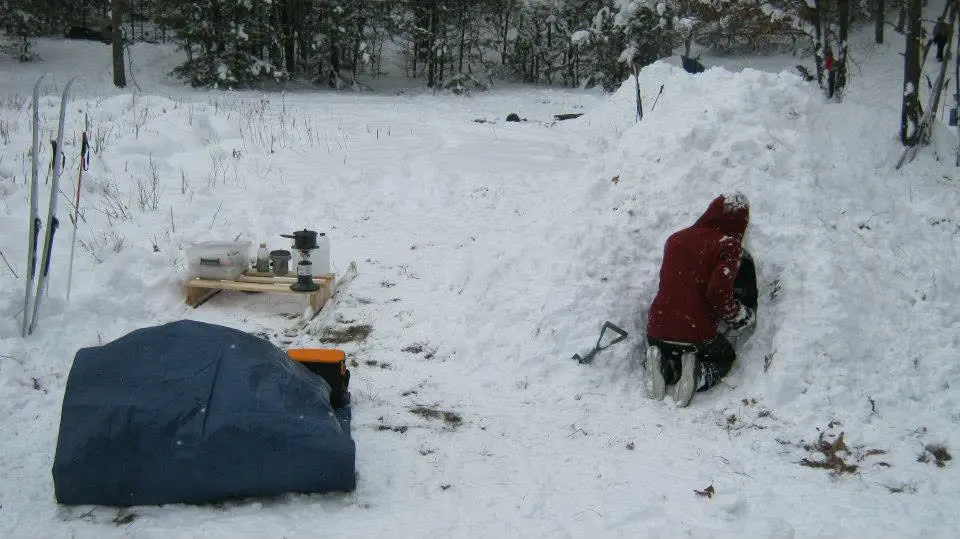
I had already built a half dozen quinzees, but it was my father’s first time. It wasn’t his first time shoveling snow for hours (the old, unreliable snowblower had made sure of that), but it was his first time sleeping in one.
Our pile of snow, hollowed out and filled with our things, was allowed to harden for the afternoon. After we reattached our skis, everyone from across the camp convened for winter s’mores by a campfire. I haven’t the slightest idea where we were. Was it The Lost Ship? Fort Clatsop? One of the campsites along the Indian Trail?
That night was, thankfully, not the coldest I had ever camped in. It only dropped to −7°F. In my experience, the inside of a quinzee is typically between 50 and 60 degrees Fahrenheit, but with my dad, it must have been closer to 70. By 2 AM the walls had melted so much that the ceiling had sunk uncomfortably close to our faces. I wasn’t grateful enough for all of the gear we had brought. The doubled sleeping bags and doubled ground mats were certainly the only reason we felt warm under that calm, clear sky.
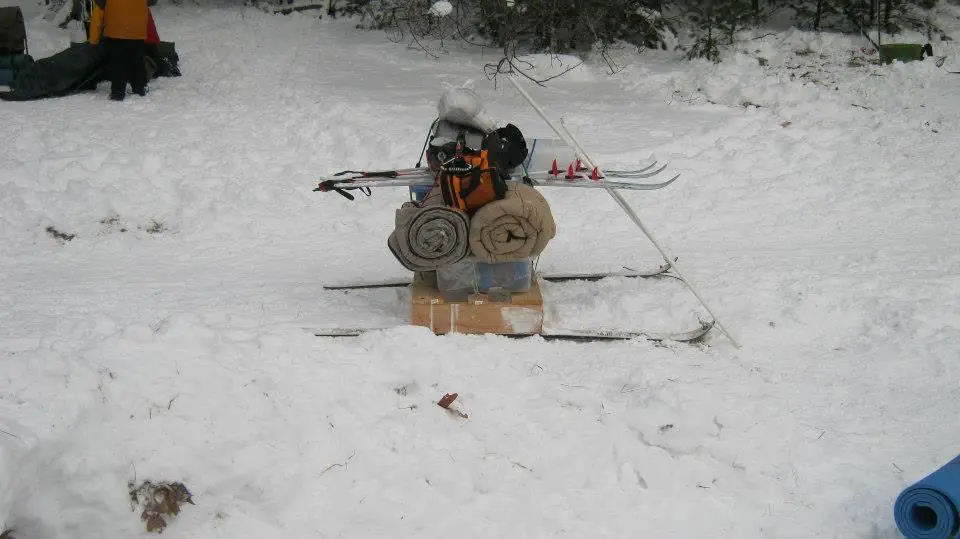
Being up early did not mean we were ready to leave early. Instead, we slept in and were the last to leave. With the sled packed a little less tidily than it was at home, we were guided back to the parking lot through a shortcut. Famously, Charlie Brown, the owner of the camp, would test the safety of Lake Briton by driving his truck onto the lake. For this particular weekend, it passed the test.
However, it was still a lake, and we had a very heavy sled. When the three of us were just barely halfway across, I heard three booms so deep that I can still recall the feeling. Was it the feeling of my stomach falling out? Was it the feeling of my feet shaking as the ice shook? Was it the feeling of panic as we each looked around, wondering if there had always only been three of us?
No one was lost, but we were too far to turn around. So the man guiding us to shore said, “You’ll forget about the ice once we start climbing the hill, but let’s move quickly” That hill was the Firebowl, and we did climb it. It was so steep that I don’t think I would have tried to ski down it. So, in a way, he was right. I did quickly forget, at least for a while, that we had nearly fallen through the ice.